
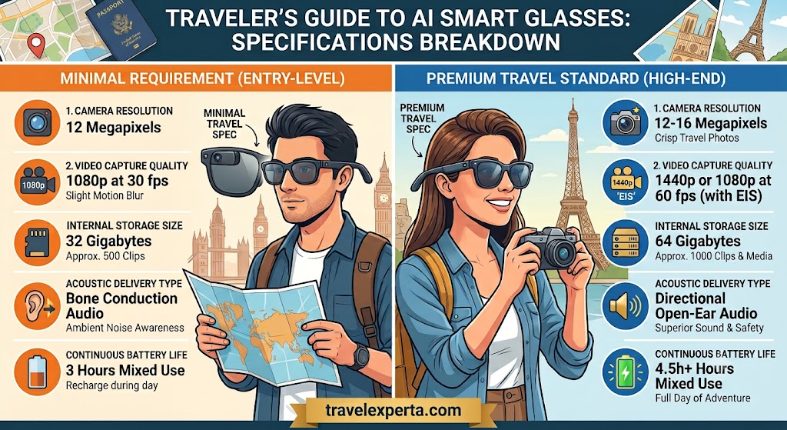
Stop buying gear based on slick promotional videos. Most travel tech is over-engineered bloatware packaged in glossy plastic. If you want smart specs that actually survive an international trip, cut through the corporate noise. Look for a 12MP camera minimum. Anything less looks like a grainy 2010 webcam. You need hands-free video at 1080p at 30fps because fumbling for a smartphone while walking through a high-theft transit hub is a rookie mistake. Open-ear audio is non-negotiable. You need to hear oncoming traffic. Demand onboard multimodal AI capable of localized, real-time translation. It needs to work instantly. Watch the physical weight. If the frames clock in over 50 grams, they will dig into your nose bridge two hours into a walking tour. It ruins the experience. Finally, insist on a hard four hours of actual operational battery life per charge. Ignore the inflated numbers the marketing teams slap on the box. Get the facts before you buy.

The Shift Toward Frictionless Travel Hardware
The traditional travel photography model is broken. Carrying a bulky DSLR with multiple heavy lenses around historic European plazas turns you into an immediate target for opportunistic street thieves. It exhausts your neck. It disconnects you from the actual experience of exploration. Modern experiential travel demands optimization, efficiency, and speed. We are seeing a massive shift toward lightweight, head-mounted computing units that let you interact with the world without a glass screen blocking your field of view.
Marketing agencies love to hype up over-complicated gear setups that cost thousands of dollars and end up collecting dust in a hotel safe. Don’t buy into the consumerism trap. The objective is to strip down your gear to the absolute essentials. The global travel sector is undergoing massive digitization, with platforms scaling rapidly to meet new consumer expectations. For context, the global online travel industry was valued at $622.6 billion USD in recent evaluations, proving that everything from booking to executing a trip is moving toward immediate digital interfaces.
Wearable tech is no longer an optional novelty for early adopters. It is a functional asset for anyone trying to streamline their transit mechanics. If you are auditing your current essential travel gear roster, your primary goal should be removing unnecessary hardware. A single pair of smart glasses can easily replace a dedicated point-and-shoot camera, a pair of wireless earbuds, and a handheld translator device. This reduction in physical baggage significantly alters your daily travel workflow. You move faster through airport security check-points. You eliminate the constant anxiety of misplacing expensive separate accessories. You blend in with the local population instead of looking like a clueless tourist.
What Are AI Smart Glasses and Why Do Travelers Need Them?
AI smart glasses are wearable eyewear frames embedded with micro-processors, camera sensors, open-ear speaker arrays, and microphones that connect directly to advanced large language models via a smartphone interface. They are designed to process visual and auditory data from your immediate surroundings to provide real-time, context-aware information. This is not clunky virtual reality. There are no massive plastic headsets here. The technology has matured to fit standard, stylish frames that look identical to classic eyewear.
The utility of these devices centers on hands-free operation and multimodal artificial intelligence. Imagine walking through a crowded market in Mexico City. Your hands are full holding street food and luggage. You’re standing in a chaotic train station staring at a sign written in a dense regional dialect. Your hands are jammed with heavy luggage. The old way is a joke. You drop your bags on a dirty floor, dig for your phone, fumble with facial recognition, and launch a slow translation app. You look clueless. You look vulnerable. Instead, you just stare at the text. You ask the frames. The internal camera snaps the frame, the algorithm crunches the pixels, and a flat, clear voice drops the English translation directly into your ear canal. Three seconds. Zero friction.
The economic scale of this technological evolution is staggering. Consumer tech giants are pouring billions into refining these micro-architectures. Data shows the global AI smart glasses market size is expanding exponentially as enterprise and consumer use cases converge. This rapid development is directly altering the travel experience. Software algorithms are becoming highly specialized for logistics and real-time navigation assistance. Experts estimate that generative AI implementations alone will inject up to $440 billion in value into global travel systems, transforming how recommendations are served and how travelers process geographic data on the move.
The true value proposition for a family traveler or a solo adventurer is the psychological liberation from the smartphone screen. When you rely on a phone to navigate an unfamiliar city, you are constantly staring down at a digital map. You miss the architecture. You miss the street art. You miss the subtle cultural interactions happening right in front of you. Smart specs flip the script. They keep your head up. They allow you to look at the world while receiving directional cues, weather updates, and historical context via discrete audio feeds.
How Do Audio and Video Specifications Impact Your Trip?
When you look at the raw specifications, hardware performance varies wildly between brands. You cannot afford to purchase a sub-par device that fails when you are thousands of miles away from home. The video recording mechanism must feature electronic image stabilization (EIS). Travel footage is inherently shaky; you are walking on cobblestone streets, stepping off trains, and moving through crowds. Without robust EIS, your captured point-of-view videos will be completely unwatchable, causing motion sickness for anyone viewing them later.
Look closely at the storage capacity of the frame. Most high-end smart specs feature either 32GB or 64GB of onboard flash storage. A 32GB drive can hold roughly 500 sixty-second video clips at 1080p resolution. If you are on a two-week international vacation and tracking your daily excursions, you will fill that space quickly. Ensure the companion mobile app offers background wireless syncing so your media transfers automatically to your phone or cloud storage while the glasses are charging.
Audio integration is another critical area where cheap hardware falls apart completely. The premier devices utilize directional open-ear speakers positioned on the temples just above your ears. This design projects sound directly down into your ear canal without sealing off your eardrum. It is a safety feature. If you wear traditional noise-canceling earbuds while walking through high-traffic zones in Paris, you will not hear an approaching vehicle or a warning shout. Open-ear audio preserves your environmental hearing. Interestingly, the consumer market has recognized this benefit clearly; the smart glasses audio segment captured over 28% of the market share in recent industry breakdowns, highlighting a major preference for open-ear acoustics over display-heavy alternatives.
Finding the right balance between style, sun protection, and smart utility requires looking at established retail providers who understand traditional eyewear aesthetics. You do not want to walk around looking like a tech-support contractor. Finding the best AI glasses means sourcing frames that offer high-grade UV protection alongside their digital components. A premium pair will feature polarized lenses to cut down glare during beach excursions or mountain hikes while housing the camera and battery arrays completely inside the acetate frame arms.
When updating your ultimate travel packing list, you must categorize these glasses as both protective eyewear and primary tech. They are dual-purpose. They shield your eyes from solar radiation while acting as your primary content capture tool. If the frame design is uncomfortable, you will leave it in your bag. Test the weight distribution before a trip. Cheaper models pack all the heavy lith-ion battery components near the front bridge, causing the glasses to slide down your nose constantly when you sweat. Premium variants distribute the component weight evenly across the entire length of the temple arms, ensuring they remain secure even during strenuous outdoor activities.
What Are the Real-World Limitations of Packing Smart Specs?
Let’s drop the corporate marketing optimism. Smart glasses are not flawless tools. They come with strict operational boundaries that will ruin your trip if you fail to plan around them. The primary issue is battery degradation and overall longevity. A frame that promises four hours of operational life will easily drop to two hours if you are constantly recording video clips and streaming audio podcasts simultaneously. If you intend to use them for an entire day of sightseeing, you absolutely must carry their specialized charging case in your daypack.
Water resistance is another major vulnerability. The majority of AI frames on the market carry an IPX4 water-resistance rating. This means they can survive a light splash or a bit of sweat. They will not survive a sudden, heavy tropical downpour in Costa Rica. They cannot be submerged in a hotel pool. If you get caught in a torrential rainstorm, you must take them off immediately and store them in a waterproof case. Failure to do so will short-circuit the microphone array, turning your expensive piece of AI tech into a regular, overpriced pair of sunglasses.
Privacy regulations present a legal hurdle that many travelers completely ignore until it is too late. Several European countries have incredibly strict laws regarding public photography and video surveillance. Most smart glasses feature a small, front-facing LED indicator light that illuminates when recording video to alert the public. Do not attempt to cover this light with tape or paint. Doing so can get you detained or fined in specific jurisdictions. When executing your long-term family travel strategies, teach your children that these devices cannot be used inside museums, sacred temples, or private establishments that explicitly prohibit photography.
Data roaming is the final hidden trap. The AI components inside these glasses do not live on the frame itself. They require a stable internet connection via your smartphone to process voice queries and visual translations. If you are traveling through rural areas with poor cellular service, or if you do not have an international data plan, the advanced AI features will cease to function entirely. You will be left with a basic camera and a pair of Bluetooth speakers. Always download offline language packs and regional maps onto your smartphone before leaving your hotel room.
Technical Parameters for Maximizing Smart Glasses Deployment
To extract the maximum value from your wearable tech ecosystem during an international itinerary, establish a strict device management routine. Charge the charging case to 100% every single night. Treat it with the same priority as your smartphone.
- Optimize Video Length: Restrict your point-of-view video captures to 15-second or 30-second bursts. Long, continuous recordings destroy the battery and create massive file sizes that slow down your wireless transfer speeds.
- Manage Data Roaming Wisely: Turn off automatic cloud backups over cellular connections. Force the companion app to sync files only when your smartphone is connected to a secure hotel Wi-Fi network.
- Maintain Lens Cleanliness: Keep a microfiber cloth in your pocket. The front-facing camera lens is highly susceptible to smudges, finger grease, and dust, which will completely degrade the clarity of your AI visual processing.
- Know Local Privacy Rules: Turn the device off entirely when entering sensitive border checkpoints, government buildings, or secure airport screening areas to avoid equipment confiscation.
The goal is operational efficiency. If you manage the technical constraints effectively, you gain an unmatched tool for capturing authentic, unscripted travel memories while moving through foreign spaces with total clarity.
Actionable Takeaways for Travel Tech Integration
Do not buy smart glasses expecting a flawless sci-fi experience. View them as a highly specialized tool designed to solve specific travel pain points. They excel at hands-free content creation and immediate contextual translation. They fail as long-duration video cameras or rugged outdoor survival gear.
Select a pair based on frame comfort, audio quality, and lens capability. Prioritize trusted eyewear manufacturers who integrate technology seamlessly over tech firms attempting to build eyewear frames for the first time. Keep your firmware updated to ensure the latest language translation models are active before you cross international borders.
Manage your power consumption patterns diligently throughout the day. Keep the charging case handy. Respect local privacy laws wherever you choose to deploy the device. By acknowledging the structural limitations of the current hardware generation, you can successfully integrate smart specs into your regular packing setup to achieve a leaner, faster, and far more engaging travel experience. Keep your head up and focus on the destination.
Last Updated on July 6, 2026
