
Planning a family RV road trip involves plenty of decisions, from choosing destinations and packing supplies to finding campgrounds along the route. One detail that can have a surprisingly big impact on your experience is the type of campsite you book.
Most RV campgrounds offer two common parking configurations: pull-through and back-in sites. Both can provide an excellent camping experience, although they involve different approaches to parking, setting up, and enjoying your stay.
For families travelling with children, pets, or a large RV, the decision deserves a little extra thought. Your arrival time, vehicle size, campsite layout, and daily activities can all influence which option works best.
A practical way to choose is to consider three things: vehicle fit, arrival fit, and family fit.

Understanding Pull-Through and Back-In RV Campsites
A pull-through campsite allows you to drive into the parking space from one end and continue forward when leaving. This straightforward layout makes it popular with larger motorhomes, fifth wheels, and travel trailers.
Pull-through sites are especially convenient during overnight stops. After a long day on the road, families can park, connect utilities, and settle in with relatively little manoeuvring.
Depending on the campsite’s dimensions and rules, some travellers can even remain hitched to their tow vehicle overnight.
A back-in campsite requires the driver to reverse the RV or trailer into position. Although this takes more preparation, back-in sites can offer appealing benefits.
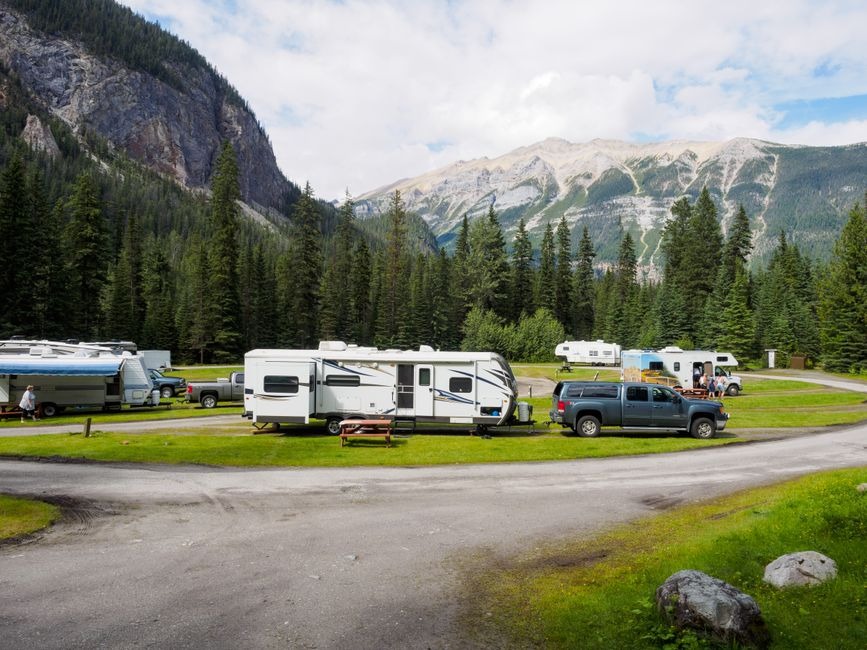
At many campgrounds, back-in spaces are located along wooded edges, quieter sections, or scenic areas overlooking lakes and natural landscapes. They may also provide more privacy for families spending several days outdoors.
Prices and layouts vary between campgrounds, so comparing specific sites is more useful than relying on general assumptions.
The Three-Fit Test: Finding a Campsite That Works for Your Family
A campsite can comfortably accommodate an RV on paper while creating challenges during arrival or throughout the stay.
Before booking, evaluate the site from three perspectives.
1. Vehicle Fit: Does Your Complete Setup Fit?
Start with the dimensions of your RV or trailer.
For a motorhome, check its overall length, width, and height. For a travel trailer, consider the trailer and tow vehicle together, especially if you hope to remain hitched overnight.
A campsite advertised for a 35-foot RV may have enough room for the RV itself while offering limited space for an additional vehicle.
Also consider what happens after parking.
Slide-outs, awnings, entry steps, outdoor furniture, and storage compartments all require clearance. Trees, utility pedestals, picnic tables, and neighbouring vehicles can reduce usable space.
Ask the campground for the actual dimensions of your assigned site and whether your complete setup can be accommodated.
2. Arrival Fit: Can You Enter the Site Comfortably?
The space available for approaching a campsite matters just as much as the parking pad.
A back-in site beside a wide campground road may be relatively easy to enter. Another site with a narrow approach, sharp turn, or nearby trees can require significantly more manoeuvring.
Arrival time also matters.
If your family expects to reach the campground after sunset, a pull-through site can simplify the final stage of a tiring travel day.
Families arriving in daylight, with enough time to inspect the space and position their vehicle, may feel comfortable choosing a back-in site.
Consider the driver’s experience, the availability of an adult spotter, and the route through the campground before making a reservation.
3. Family Fit: Will the Site Be Comfortable Once You Park?
Parking is only the beginning of the camping experience.
For a family staying several nights, the surrounding space can have a greater impact on enjoyment than the initial manoeuvre.
Think about where children will play, how much space your outdoor seating area needs, and whether the campsite provides comfortable access to walking paths, bathrooms, or playgrounds.
A back-in site facing a lake or wooded area may offer a particularly enjoyable setting.
A pull-through site near campground amenities could be more convenient for families who expect to move around frequently.
Check which direction your RV door and awning will face. Afternoon sun, shade, neighbouring campsites, and traffic along nearby roads can all affect how pleasant your outdoor space feels.
Match the Campsite to Your Road-Trip Schedule
Your itinerary can help determine which site type offers better value.
Imagine a family driving across several states and stopping for one night before continuing early the next morning.
A pull-through campsite makes sense in this situation. The family can arrive, prepare dinner, rest, and leave the following morning with fewer parking and departure complications.
Now imagine the same family spending four nights beside a national park.
They plan to explore local trails, cook outdoors, and spend evenings around the campsite.
A spacious back-in site with shade, privacy, and a pleasant view may provide a better experience throughout the stay.
Budget also deserves consideration. Some campgrounds charge more for pull-through sites, while others price both configurations similarly.
Compare the actual nightly or weekly rates alongside the campsite’s location and amenities.
A useful decision rule is to prioritise easy access for short overnight stops and overall campsite comfort for longer stays.
Make Back-In Parking Easier With a Family Arrival Routine
Backing an RV into a campsite becomes more manageable when everyone knows what to do.
Before approaching the parking space, stop somewhere permitted and inspect the site on foot.
Look for tree branches, rocks, picnic tables, utility connections, uneven ground, and other obstacles. Check that the intended parking position leaves enough room for slide-outs and doors.
If another adult is available to help, agree on simple hand signals or use two-way radios. The spotter should remain visible to the driver and stand well clear of the vehicle’s path.
Children and pets should stay safely away from the manoeuvring area under the supervision of another responsible person.
Once everyone is in position, reverse slowly and make small steering adjustments. Stop whenever visibility becomes unclear or communication with the spotter is interrupted.
An rv backup camera can provide an additional view behind a motorhome or camper, helping the driver monitor the area directly behind the vehicle during low-speed manoeuvres.
Cameras work best alongside mirrors, direct observation, and clear communication with a spotter.
Taking a few extra minutes to position the RV carefully helps everyone begin the camping experience on a more relaxed note.
Prepare Your RV’s Visibility Equipment Before Departure
The best time to address camera or visibility problems is before leaving home.
Check mirrors, clean camera lenses, inspect rear lights, and confirm that any installed reversing system displays a clear image.
For owners considering a camera retrofit, a wireless backup camera may simplify installation by reducing the need for long video cable runs between the rear camera and the front display.
This can be particularly useful for longer RVs and trailers, where routing cables through the vehicle may involve additional work.
Before travelling, verify that the system is suitable for your vehicle’s length and configuration. Check its power requirements, signal stability, display position, and performance with the complete towing setup connected.
Practise using the camera in a familiar, open area so you know what its field of view covers.
A reliable rear-view system can make an unfamiliar campground easier to navigate, especially when combined with a deliberate parking routine.
Five Questions to Ask Before Booking
Once you have narrowed down your campsite options, a short conversation with the campground can prevent surprises on arrival.
Ask these five questions:
- What are the actual dimensions of the assigned site? Confirm that your RV, tow vehicle, and extended equipment will fit.
- How wide is the approach road? Ask whether sharp turns or nearby obstacles could make parking difficult.
- Where are the utility connections located? Confirm that your electrical, water, and sewer connections will be accessible once parked.
- What is the surrounding layout? Ask about shade, privacy, pedestrian traffic, and the position of neighbouring campsites.
- Can you provide a site photo or campground map? A visual reference can help you understand the parking approach and usable outdoor space.
These questions are particularly useful when travelling with a large RV or booking a campground for the first time.
Choosing the Best Campsite for Your Next Family Adventure
Pull-through and back-in campsites each have advantages.
Pull-through spaces offer convenient entry and departure, making them attractive for large RVs, quick overnight stays, and families arriving after long driving days.
Back-in spaces can provide excellent value, attractive surroundings, and comfortable outdoor areas for longer camping holidays.
The best choice depends on how well the site accommodates your vehicle, how easily you can reach your parking position, and how your family plans to enjoy the space.
Use the three-fit test before booking, confirm the details with the campground, and prepare your parking routine before arrival.
A little planning can turn campground arrival into a straightforward part of the journey, leaving more time for the experiences that make a family road trip memorable.
Last Updated on October 22, 2026
